Cracks from a shifting slab
Diagonal lines off door and window corners, opened up, taped, coated and blended back in.
Settling crack repairParker County walls and ceilings
Settling cracks, popped nails, punched-through holes and water-stained ceilings, repaired, blended into the knockdown or orange peel around them and handed back primer-ready.
One call or one form. You see a price before anything gets touched.
Dial in and the ticket gets routed to the pro on your route, who rings back, sizes it up by phone and names a figure.
Call 7 days, 7am–9pm
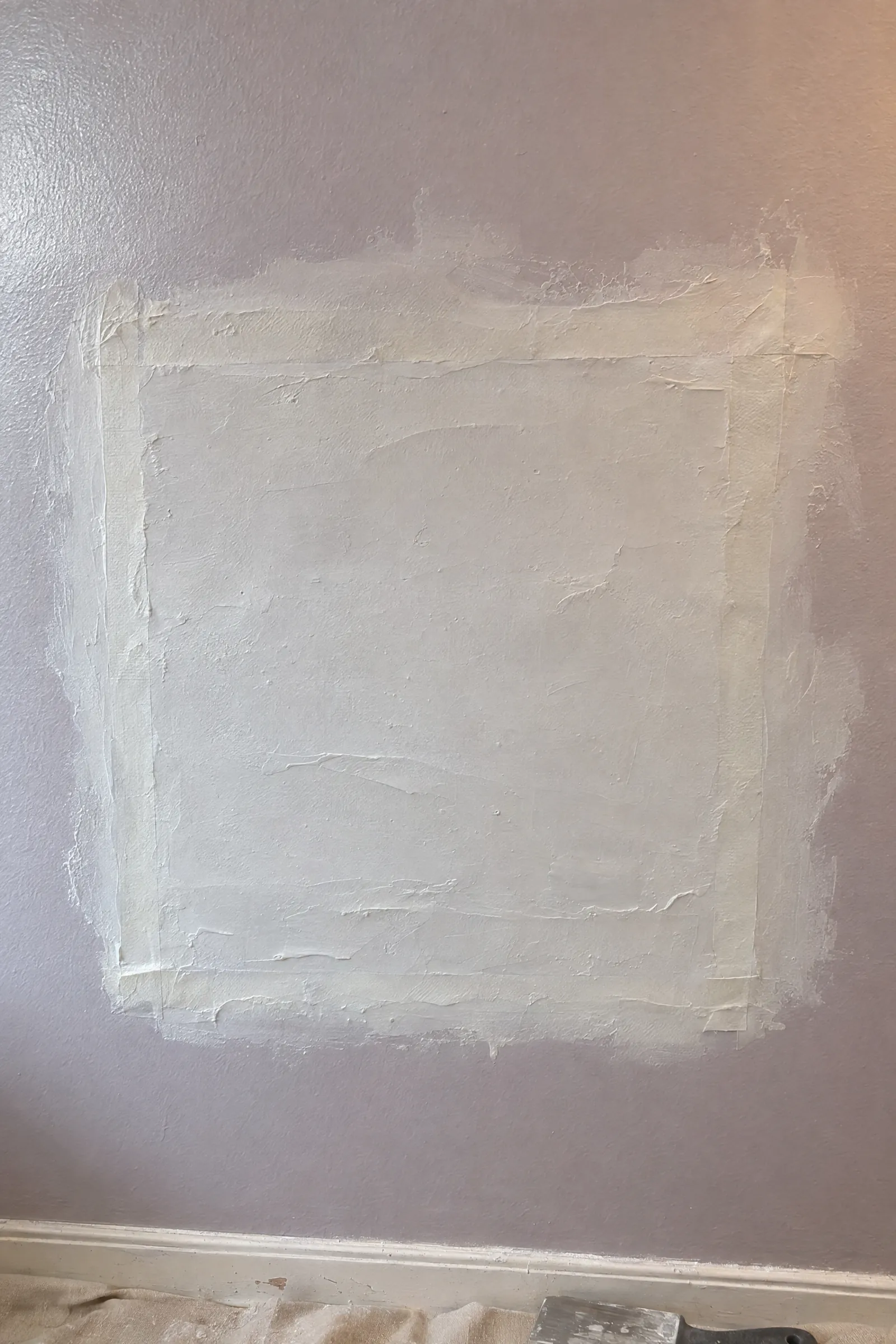
Water in a wall or ceiling is a sequence job. Work it in order. Patch over wet board and the ring tends to bleed back through new paint, or the tape lets go a month later.
Close the valve at the fixture or shut the main. Storm came through the roof? Get it tarped and get a roofer booked. Nothing else on this list counts until the source is off.
Ceiling bulging or dripping? Breaker box first. Cut the circuits to every fixture overhead in the wet zone. Then clear the floor under it: people, pets, furniture. Put a bucket where it drips.
Fans and a dehumidifier, doors open, for as long as it takes. Gypsum holds water well after the surface feels dry. Soaked insulation behind it holds even more.
The check that counts is a meter reading off the board around the stain. Touch lies. Dry readings: keep the board, seal the ring. High readings: it comes out.
Board that's gone soft, crumbly, saggy or musty comes out until the saw reaches sound gypsum, and new goes in. Hard, dry board under a ring usually just takes a sealer coat and paint. Then send a photo. The full sequence is on the wet drywall and stained ceiling page.
Pick the card that matches the wall. Each page covers the cause, what the fix takes and what to watch for. Not sure what you're looking at? Check your problem against the triage list further down, or send a photo with the form.
Diagonal lines off door and window corners, opened up, taped, coated and blended back in.
Settling crack repairRound bumps over fasteners reset, and seams re-taped where the old tape has bubbled or split.
Pops and lifting tapeTexture rebuilt over a repair so it carries the same surface as the wall beside it.
Knockdown and orange peelDoorknob dents to fist-size breaks: squared up, backed, patched, coated and textured.
Patching a holeStained or soft board after a leak, sealed or cut out depending on what the meter says.
Leak damageFill it in. Room, damage, rough size. Two pictures beat a long message: one tight on the damage, one wide enough to show the wall. The callback is where questions get asked and the price gets set.
Voice works too: (682) 398-2021 · Call 7 days, 7am–9pm
Your request is routed to the pro covering your street, who rings back to ask questions and name a price.
Willow Park sits west of Fort Worth in Parker County, part of the Western Cross Timbers. The weather swings here are the North Texas kind, and each one leaves its own marks indoors.
August averages a 96-degree high in nearby Fort Worth. Hot, dry spells dry out the soil around foundations until it shrinks and pulls away from the house. When a slab moves even a little, the drywall above it shows it: diagonal cracks from door and window corners, doors that start to rub, tape lines that open.
The Fort Worth area is very susceptible to supercell thunderstorms that drop large hail. Cracked shingles let rain in, and the first sign inside is often a tan ring on a ceiling or a damp patch up near the top of an exterior wall.
In February 2021, DFW Airport hit −2°F, the coldest North Texas had seen in 72 years, and plumbing burst in buildings across the state. Supply lines in outside walls and attics are the weak spot. When a hard freeze is forecast, open sink cabinets on outside walls and let a faucet drip.
Summers here are hot and muggy, humid subtropical on the climate maps. A bathroom with a weak exhaust fan collects moisture on the ceiling above the shower, and that's where tape joints soften and paint starts to peel.
Request to repaired wall, in five moves. You make one call or send one form. The scheduling is on us.
Ring during calling hours or use the form. Give the what and the where. Snap the damage up close, then the whole wall.
The pro on your route rings you, asks what a picture can't show and prices the job. The number lands before a single tool comes out. No sign-off, no start.
Say yes and the repair gets a day and a time window. Mention pets, gate codes or a painter already lined up, and it goes on the ticket.
Patch, tape, coats, sanding, texture. Bigger jobs can run to a second day, because mud has to harden between coats.
A flat, texture-matched surface, primer-ready. Want paint as well? It gets priced as a separate line.
Same steps for a nail hole or a ceiling section. Listed below, so you know what to move out of the way and why there are drying gaps.
Cloths on the floor, furniture pulled clear or sheeted over. Take breakables off shelves on that wall the night before.
Loose paper is trimmed, cracks are V-cut, popped nails are set and backed up with a new screw, and holes are squared so a patch fits tight.
Bigger holes get a wood backer or clips behind them, and a fresh panel piece goes in on screws. The drawing below shows the layers.
Tape across every joint, then two or three coats of mud, each one broader and leaner than the one under it. Each cures before the next.
Sanding with dust control, then texture, sprayer or hand, to suit the neighboring surface.
A proper job finishes with dust and offcuts cleared and the cloths lifted. The patch is primer-ready; the pro will give the wait before paint.
Calls come in from across this corner of Parker County and the west edge of Tarrant.
Where we work lists each town with a little more detail.
Not every mark needs a call this week. Sort it here.
Breaker off for the lights and fan in that area first, then everyone out from under it. A wet ceiling panel is heavy and can drop without warning. Call once the water source is stopped.
A ring that widens is still being fed. Find the source, or get a plumber or roofer on it, then book the drywall.
That's movement still going on. Have the foundation looked at by a foundation contractor first; drywall goes back last.
Tick both ends in pencil, dated. Same length a month on? Park it for a later booking.
Cosmetic. Let them collect and book them as one visit with anything else on the list.
Leak fixed, panel hard to the touch and reading dry? That's stain blocker plus paint, on your schedule.
Move-out inspections, buyers and listing photos all catch the same few things. Fix those. Leave the rest.
Doorknob holes behind doors. Anchor holes from a TV mount. Crushed outside corners in hallways. Any ceiling stain, because a buyer will ask about the leak behind it.
A hairline crack in a closet or garage. A single pop high on a wall. Those rarely move a walk-through or a photo.
Drywall first, painters second. Compound needs dry time before primer, so book the repair before the painter and leave a gap between them. Get the dry time from the pro on the pricing call.
List every hole, anchor and dent in one request. One booking for the whole house usually costs less than several small trips.
Ballpark first. This Old House prices small holes around $60–$200, a crack at $60–$330 and a ceiling hole at $320–$1,300, all national averages. Willow Park jobs aren't priced off that list. The figure for your wall is set on the callback, and it swings with the six items below.
One small hole and six small holes are not six times the price. Group the list into one booking.
Overhead takes longer: more ladder, more masking below.
Knockdown and orange peel have to be rebuilt over the patch. That's an extra step and extra drying.
Soaked panels need drying days and replacing, often insulation too. Mold calls for a different trade.
The repair ends primer-ready. Paint is an add-on line if you want it.
Tall entry walls, stairwells and full bookcases all add time.
These turn up in houses of every age. Each one, with what a proper fix involves.
Squared, backed, fresh drywall fastened in, taped, coated, textured. Add a door stop or the same hole comes back.
Each fastener reset with a new screw beside it, spot coats over each, then texture to match.
Grooved, taped across, coated and feathered. If it reopens within a season, the house is still moving.
Leak found and fixed first, usually by a plumber. Then the meter decides: seal and paint, or cut and replace.
Have the room, the damage and a rough size ready. That's all the first call needs.
Either route, the ticket ends up with the pro covering your street, and a pricing call follows.